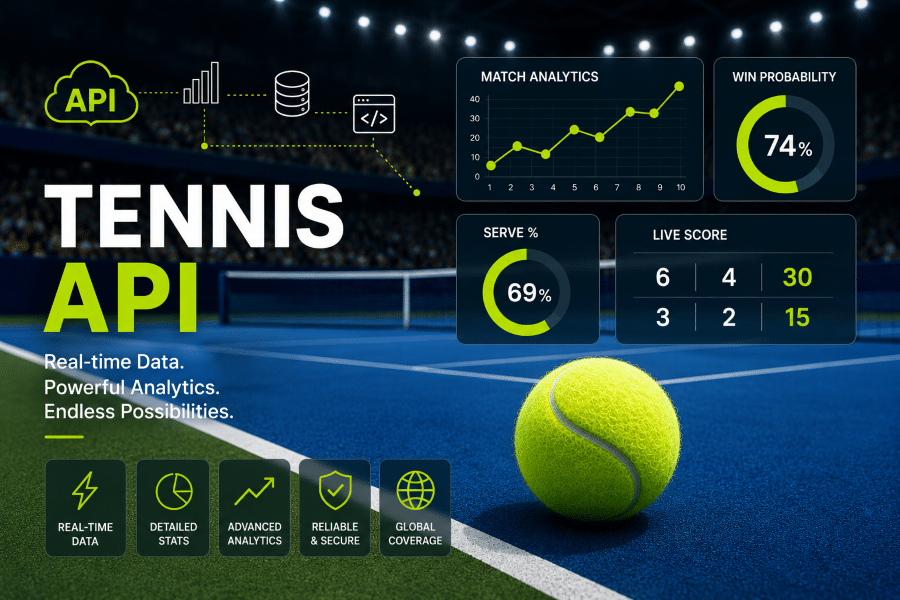
Professional tennis has always been a sport driven by detail. Small adjustments in timing, movement, serving patterns, or mental composure can dramatically change the outcome of a match. For decades, coaches and analysts relied primarily on observation, handwritten notes, and post-match statistics to evaluate player performance.
That environment has changed completely.
Modern tennis analysis is now increasingly powered by live data systems capable of processing thousands of real-time events during matches. Analysts can now evaluate momentum shifts, pressure performance, serve efficiency, tactical adjustments, and predictive probabilities as matches unfold point by point.
As structured live feeds become more widely available through platforms such as professional tennis analytics platforms, real-time data is fundamentally changing how professional tennis is studied, forecasted, and understood.
The result is a much deeper analytical environment where performance can be measured dynamically rather than simply reviewed after matches are complete.
The Shift Away from Traditional Tennis Analysis
Historically, tennis analysis focused heavily on basic metrics such as:
- Win-loss records
- ATP and WTA rankings
- Head-to-head history
- Recent tournament results
- Surface records
While these indicators remain important, they provide only a broad summary of player quality.
Modern analysts now increasingly focus on:
- Point-by-point momentum
- Serve efficiency under pressure
- Break point performance
- Shot tolerance in long rallies
- Surface-adjusted statistical trends
- Fatigue-related performance decline
This shift has transformed tennis from a largely observational sport into one of the most analytically sophisticated environments in professional athletics.
Why Tennis Is Ideal for Real-Time Analytics
Tennis is uniquely suited for live statistical analysis because of its structured scoring system.
Every point directly influences:
- Game probabilities
- Set probabilities
- Match win expectations
- Pressure dynamics
- Momentum progression
Unlike sports with continuous play and chaotic movement, tennis provides clearly segmented scoring events that are relatively easy to isolate and analyze statistically.
This creates ideal conditions for:
- Predictive modeling
- Live probability systems
- Machine learning analysis
- Performance trend tracking
- Automated forecasting
Real-Time Serve Analysis
Serving remains one of the most important components of professional tennis.
Live data systems now track serving performance dynamically throughout matches using metrics such as:
- First serve percentage
- First serve points won
- Second serve efficiency
- Ace frequency
- Double fault trends
- Break points saved
These live updates allow analysts to detect performance shifts immediately.
For example, declining first serve percentages late in matches may indicate:
- Physical fatigue
- Pressure-related tension
- Tactical adjustments
- Reduced movement efficiency
Without live data processing, many of these patterns would remain difficult to identify during active competition.
Return Performance Is Becoming More Important
While serving receives much of the attention, modern analytics increasingly recognizes return performance as one of the strongest indicators of long-term consistency.
Live return metrics often include:
- Return points won
- Second serve return aggression
- Break point conversion rate
- Return depth consistency
- Pressure-return efficiency
Strong returners tend to maintain stable performance across varying conditions, especially on slower surfaces such as clay.
Real-time return analysis allows forecasting systems to evaluate whether players are gaining tactical control during matches even before scorelines fully reflect those shifts.
Momentum Analysis Has Changed Significantly
Momentum has always been one of the most discussed concepts in tennis, but historically it was difficult to measure objectively.
Modern live analytics systems now attempt to quantify momentum using:
- Consecutive points won
- Recent hold percentages
- Break point creation trends
- Average rally length
- Recent serve effectiveness
These systems can identify subtle momentum shifts long before they become visible through scorelines alone.
For example, a player consistently extending rallies and creating pressure on return may be gaining tactical control even while temporarily trailing on the scoreboard.
Surface Conditions Create Different Live Dynamics
Surface variation remains one of the defining characteristics of professional tennis.
Live analytical systems increasingly adjust models depending on court conditions.
Grass Courts
Grass generally rewards aggressive serving and short rallies. Momentum swings tend to occur rapidly because service breaks are less common.
Clay Courts
Clay creates slower conditions and longer rallies, meaning probability shifts tend to occur more gradually.
Hard Courts
Hard courts often create more balanced environments where both serving and returning heavily influence momentum changes.
Because of these differences, advanced forecasting systems now incorporate surface-adjusted live modeling.
The Importance of Pressure Metrics
One of the biggest developments in modern tennis analytics is the growing emphasis on pressure performance.
Not all points carry equal importance during matches.
Modern systems increasingly track:
- Break point efficiency
- Tie-break performance
- Deciding set records
- Pressure-point serve percentages
- Clutch return efficiency
Some players consistently elevate their level during critical moments, while others experience noticeable declines under pressure.
Live data systems allow these tendencies to influence forecasting dynamically throughout matches.
Historical Data Still Matters
Even though real-time analytics has become increasingly important, historical databases remain essential.
Live forecasting systems still depend heavily on long-term performance trends including:
- Surface-adjusted win rates
- Serve and return efficiency
- Historical matchup performance
- Tournament-level results
- Fatigue and scheduling patterns
Many analysts evaluating predictive systems compare providers based on statistical depth, historical consistency, and live update reliability when reviewing the best tennis data APIs for professional analytics.
Machine Learning Is Expanding Tennis Forecasting
Machine learning systems have dramatically increased the complexity of modern tennis analysis.
AI-driven models can now process enormous live datasets and compare current match situations against thousands of historical patterns.
Modern predictive systems increasingly use:
- Gradient boosting algorithms
- Bayesian forecasting models
- Regression analysis
- Neural networks
- Dynamic probability systems
These models continuously update predictions as new information becomes available during matches.
How Live Data Supports Sports Media
Broadcasting and sports media have also changed dramatically because of real-time analytics.
Modern broadcasts now regularly display:
- Serve speed trends
- Win probability graphics
- Pressure-point statistics
- Return efficiency comparisons
- Historical matchup records
This has made professional tennis broadcasts significantly more analytical and data-driven than they were even a few years ago.
The Growing Demand for Live Match Coverage
As tennis audiences increasingly expect immediate information, demand for reliable live match tracking continues growing rapidly.
Fans now expect access to:
- Live scores
- Match statistics
- Upcoming schedules
- Player trends
- Real-time rankings
Platforms covering upcoming ATP and WTA matches increasingly integrate live statistical systems to provide deeper context beyond simple score updates.
Data Reliability Has Become Critical
As live analytics systems become more advanced, data reliability becomes increasingly important.
Even small inconsistencies can disrupt:
- Probability models
- Broadcast graphics
- Betting integrations
- Machine learning pipelines
- Automated alerts
This is why mature sports data providers place enormous emphasis on:
- Infrastructure stability
- Low latency delivery
- Historical consistency
- Structured formatting
- Global redundancy systems
Reliable live data is now viewed as a core requirement rather than an optional feature within modern sports technology.